
Product Categories
PRODUCT CATEGORYContact Us
CONTACT USMobile phone:+86-15395152932
mail:sale@oamisys.com
Address:Electronic Information Industrial Park, Shunyi District, Beijing City
The Importance of Chain Plates in the Manufacturing of Motorcycles, Two‑wheelers, Three‑wheel Fuel‑powered Vehicles and Electric Vehicles
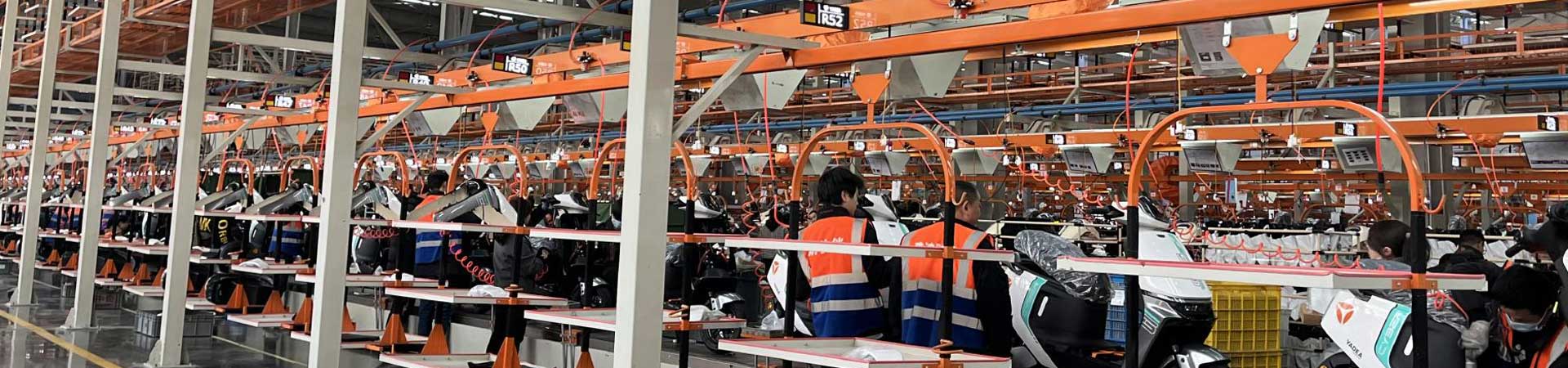
In the manufacturing of motorcycles, tricycles and electric two‑wheelers, the slat chain conveyor is the core equipment of any final‑assembly workshop. Yet unlike most high‑precision automation, its strongest selling point is not precision — it is tolerance for abuse. Engine oil dripping onto the line, metal chips flying through the air, the shock load released at the instant an engine is lowered into place: these harsh conditions are precisely the environment in which a slat chain conveyor performs at its best.
Everything rests on a single core component: the cold‑rolled steel slat.
Impact resistance — cold‑rolled steel slats and needle roller chains absorb the shock of engine and battery‑pack hoisting
Oil and contamination resistance — a galvanized slat surface shrugs off engine oil, gear oil, cutting fluid, rubber dust and swarf
Modular repairability — a cracked slat is unbolted and swapped out, with no full‑line shutdown
No precision upkeep — no belt re‑tensioning, no cleaning of oil out of roller gaps
I. Cold‑Rolled Steel Slats — Where the “Unbreakable” Character Comes From
Slats on domestic vehicle assembly lines are typically made of A3 cold‑rolled steel plate (a Chinese GB grade broadly comparable to Q235 / ASTM A36 mild steel) or high‑strength steel plate, in thicknesses from δ = 2.5 mm to δ = 5 mm, usually finished with a galvanized coating for corrosion protection. The combination looks plain, yet in a real final‑assembly shop every layer of it has a reason to exist:
High rigidity of cold‑rolled steel. Steel plate is inherently rigid and resists permanent deformation under concentrated load. This is the physical basis on which a slat absorbs the impact of engine or battery‑pack hoisting.
Galvanized surface resists oil and dirt. Floors and equipment surfaces in a final‑assembly workshop are in permanent contact with engine oil, gear oil, hydraulic oil, rubber dust and metal chips. Once a cold‑rolled steel slat is galvanized, oil dripping onto it does not soak in, splashed water and cutting fluid do not start rust, and a quick wipe is all it takes to keep running.
Brutally simple structure. One steel slat plus one needle roller chain — no belt, no precision rollers, no pneumatic take‑up unit. The simpler the structure, the lower the probability of failure, and the lower the skill threshold for repair.
Put bluntly, what cold‑rolled steel slats deliver comes down to one word: ruggedness — with one implicit attribute attached, impact resistance. These two points are what make the slat chain conveyor irreplaceable in a vehicle final‑assembly workshop.
II. Four Engineering Advantages — Why Slat Chain Conveyors Survive Hostile Working Conditions
Starting from the properties of the cold‑rolled steel slat, four core engineering advantages emerge on the vehicle‑manufacturing shop floor. These four advantages are the real reason it works across every segment of the industry.
1. Impact Resistance — Hoisting Is Not “Setting Down,” It Is “Dropping On”
On a final‑assembly line, hoisting an engine or a battery pack is not a process of uniform loading. The spreader descends, aligns and releases; at that instant the slat takes a near free‑fall impact load rather than a static weight.
A motorcycle engine weighs 30‑80 kg. Add the hoisting fixture and the concentrated reaction force from the front section of the frame, and the real impact load at the locating point often approaches 150‑300 kg. Battery packs on electric tricycles are heavier still: 48V/60V/72V lead‑acid or lithium‑ion packs range from 30 to 200 kg, so the impact at the moment of landing is greater again.
The cold‑rolled steel slat plus needle roller chain combination is rigid enough that the impact load is distributed across the entire needle‑roller chain link, causing no local depression and no chain jumping over the sprocket teeth. That is something belt conveyors — whose belts get hammered into permanent dents — and light‑duty roller conveyors — whose roller bearings deform under shock — simply cannot achieve.
2. Oil and Contamination Resistance — A Final‑Assembly Shop Is Not a Clean Room
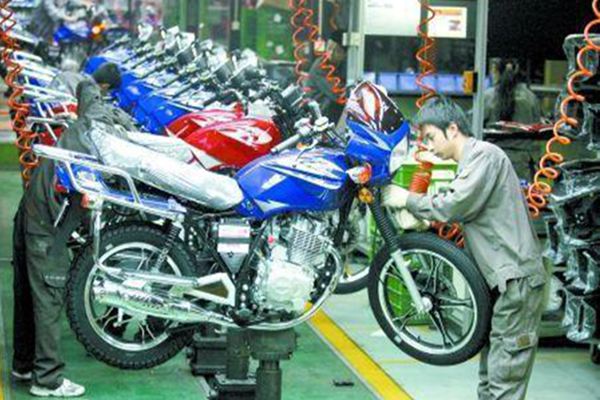
At a motorcycle engine‑assembly station, dripping engine oil and splashed gear oil are routine. At the rear‑axle station of a three‑wheeled motorcycle, contamination from gear oil and grease is heavier still. Electric bicycles use no engine oil, but rubber dust fills the air at the tire‑fitting station, and swarf from metal fasteners also falls onto the conveying surface.
In this environment:
- Belt conveyors: oil causes slipping, ageing and cracking on contact, and service life is cut in half.
- Roller conveyors: oil and metal chips jam into the gaps, rollers seize, and maintenance frequency becomes extremely high.
- Slat chain conveyors: the steel slat surface fears neither oil, dirt nor water — wipe it off and carry on. The galvanized layer also prevents long‑term corrosion from cutting fluid and cleaning agents.
This is the greatest practical advantage of a slat chain conveyor: it needs no clean room and no careful upkeep, and runs just as well when covered in oil and dust.
3. Modular Repairability — Break One Slat, Replace One Slat
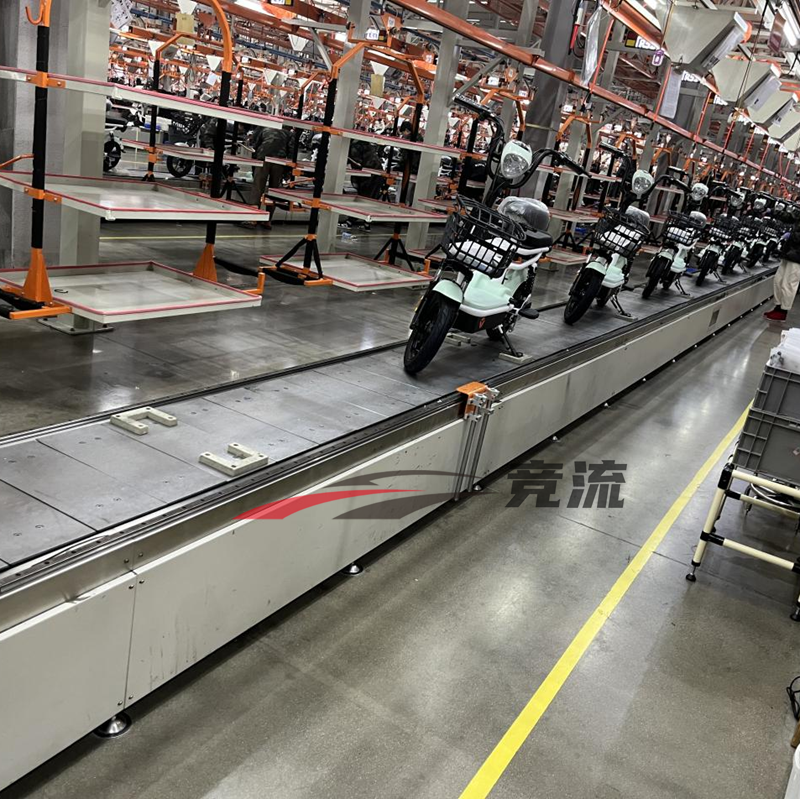
The slats of a slat chain conveyor are modular elements connected in series on a needle roller chain. When one slat cracks from long‑term offset loading or an accidental impact, the repair could not be simpler: take off the damaged slat, fit a new one, and reconnect the chain. The whole job requires no full‑line shutdown and does not disturb the takt time of other stations.
By contrast, if a section of belt on a belt conveyor wears through or tears, the usual procedure is to release the take‑up unit, cut the belt and re‑vulcanize the splice — a job measured in hours, with the entire line at a standstill. If a roller on a roller conveyor seizes, the bearing housing must be dismantled, the old roller taken out and a new one pressed in — equally time‑consuming and labour‑intensive.
For a production line, downtime is loss. The “break one, replace one” nature of a slat chain conveyor gives it overwhelming superiority in maintainability over every other conveying solution.
4. No Precision Maintenance — Not Fragile, Not Demanding
What a plant owner cares about is not how impressive the equipment datasheet looks, but three down‑to‑earth questions: will this line run three years without failing? If it fails, can it be fixed the same day? Does it need someone looking after it all the time?
A slat chain conveyor scores on all three:
Three years without failure. Steel slats plus a needle roller chain, with a structure so plain that there is nothing precise enough to break at a touch. Under normal conditions a slat chain conveyor runs three to five years without a major overhaul.
Fixed the same day. As described above, modular slats turn repair into “swap a part” rather than “repair a system.”
No babysitting required. There is no periodic tensioning or belt replacement as with belt conveyors, and no daily cleaning of oil and chips out of roller gaps. Routine work is limited to periodically checking chain tension and needle‑bearing lubrication, so maintenance cost stays extremely low.
III. Industry‑Wide Coverage — How the Four Advantages Map onto Eight Production Lines
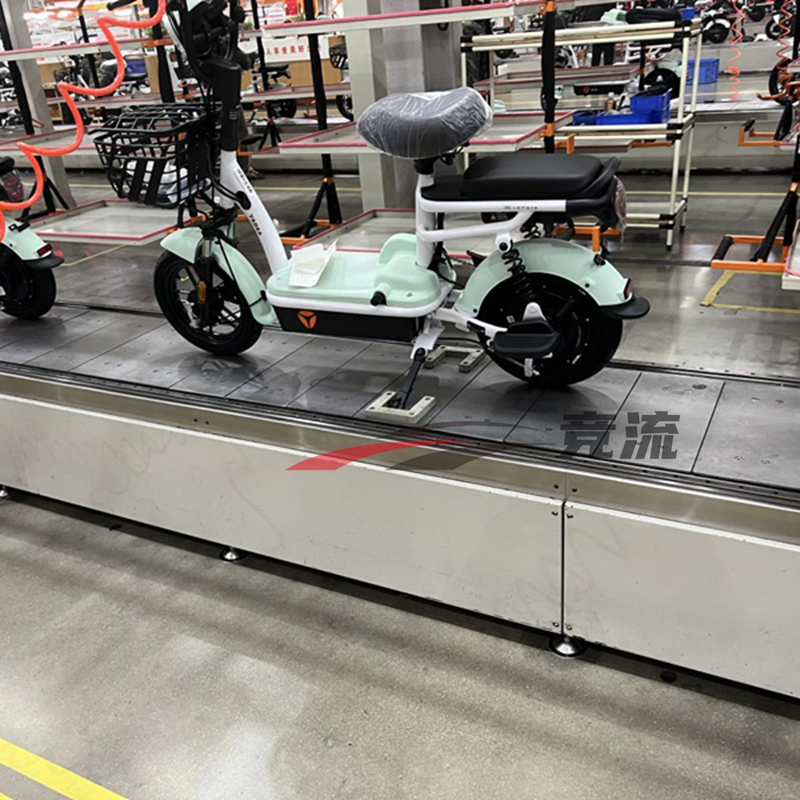
Using these four engineering advantages as a lens, and looking again at the eight segments of two‑ and three‑wheeler manufacturing, the technical logic of the slat chain conveyor turns out to be consistent throughout. The only difference is which advantage each segment leans on most.
| Production Line | Most Prominent Advantage | Engineering Scenario |
|---|---|---|
| Motorcycle Assembly Line | Impact resistance + oil and contamination resistance | Shock from engine hoisting, plus dripping engine oil and gear oil |
| Three‑Wheeled Motorcycle Line | Impact resistance + oil resistance (stronger) | Heavier oil contamination at rear‑axle assembly; greater shock from cargo‑box hoisting |
| Electric‑Tricycle Line | Impact resistance + modular repair | Heavy shock from battery‑pack hoisting and high offset‑load risk, calling for separate load verification and fast repair |
| Electric‑Motorcycle Assembly Line | Oil resistance + anti‑static | Lithium‑battery assembly needs an ESD‑safe slat line, yet the base material is still cold‑rolled steel |
| Electric‑Bicycle Production Line | Modular repair + no precision upkeep | Fast takt time and frequent changeovers make downtime costly, so modular repair clearly pays off |
| Moped / Scooter Assembly Line | Impact resistance + no precision upkeep | Sits between motorcycles and electric bicycles, with moderate levels of shock and oil contamination |
| Low‑Speed EV / Mobility‑Scooter Line | Impact resistance (strongest) | Heavy, near‑automotive bodies produce the largest hoisting shock loads |
| ATV / UTV Line | Impact resistance (extreme) | Unit vehicle weight of 200‑500 kg puts it in heavy‑duty slat territory, with shock loads far beyond ordinary two‑wheelers |
As the table shows, in every segment impact resistance and oil resistance are baseline capabilities delivered by the cold‑rolled steel slat, while modular repair and freedom from precision upkeep are the bonus points at the plant‑operations level. Together, these four advantages form the complete technical portrait of a slat chain conveyor that is “crude but always running” in two‑ and three‑wheeler manufacturing.
IV. On Line Length — Decided by Process Requirements and Budget Alike
When the common parameters of slat chain conveyors were discussed earlier, 30 meters was used as a reference benchmark. That needs qualifying here: 30 meters is a length that industry experience has proven reliable. It is not an iron law.
In a real project, line length is decided by two things working together:
Process requirements. Number of stations × floor space required per station = theoretical minimum line length. The more stations, the longer the line.
Budget constraints. A small plant short of money can compress the line to 20 meters or even less, pack the stations tightly and compensate by speeding up the takt. A large plant with a comfortable budget can run 60 meters or more, with roomy stations, comfortable working positions and a relaxed takt.
So the more accurate way to describe 30 meters is “the minimum configuration that is good enough,” not “the standard length.” What really decides whether a slat chain conveyor is usable is not its length, but whether the four engineering advantages delivered by cold‑rolled steel slats cover the actual needs of the production line.
Conclusion
The central position of slat chain conveyors in two‑ and three‑wheeler manufacturing is not propped up by the good‑looking figures on a datasheet — “200‑500 kg point load, 500 kg per meter.” It rests on how cold‑rolled steel slats actually behave in a working factory: impact resistance, oil and contamination resistance, modular repairability, and freedom from precision maintenance. These four advantages make it the only conveying solution that can be “crude and still keep running” across eight major segments: motorcycle assembly lines, three‑wheeled motorcycle lines, electric‑tricycle lines, electric‑motorcycle assembly lines, electric‑bicycle production lines, moped/scooter assembly lines, low‑speed electric vehicle and mobility‑scooter lines, and ATV/UTV lines.
For equipment manufacturers, explaining these four engineering advantages clearly is far more persuasive than listing a hundred technical parameters. Because everyone on a shop floor knows one thing: the most valuable asset on a production line is not the equipment itself — it is uptime.
Previous:Intelligent Station-divided Assembly Line For AC & DC Integrated Charging Piles
Next: