
Mobile phone:+86-15395152932
mail:sale@oamisys.com
Address:Electronic Information Industrial Park, Shunyi District, Beijing City
As the global automotive industry accelerates its transition toward electrification, the demand for reliable, high-capacity charging infrastructure has reached unprecedented levels. Our EV charging pile assembly line stands at the critical intersection of electrical engineering, industrial manufacturing, and infrastructure deployment, delivering the charging stations that power the world’s growing fleet of electric vehicles.
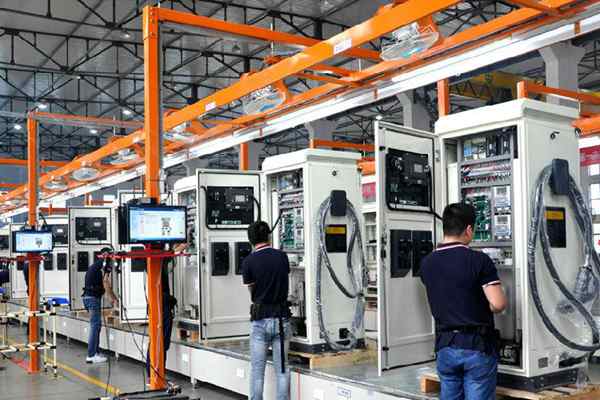
Linear Station-Based Configuration. The assembly line shown in our facility employs a linear station-based configuration optimized for the unique physical and electrical characteristics of charging pile manufacturing. Unlike traditional automotive assembly lines that handle moving vehicle chassis, our line manages large-format electrical enclosures that remain stationary at each workstation while components are progressively installed and tested.
Structural Framework. The structural framework of the line features heavy-duty steel support columns finished in high-visibility orange, a color convention that serves both safety and operational functions. These vertical supports anchor the overhead conveyor and power distribution systems, creating a robust infrastructure capable of handling the substantial weight of fully assembled charging units. The open-truss ceiling design provides ample clearance for overhead crane operations and ventilation systems, while industrial-grade LED lighting ensures consistent illumination across every workstation.
Precision Roller Bed System. The floor-mounted conveyor system utilizes precision-engineered roller beds that allow smooth lateral movement of charging pile enclosures between stations. Each station is spaced according to the complexity of operations performed, with wider intervals allocated for wiring-intensive and testing phases where technicians require extended access time. This variable-spacing approach optimizes line balancing and prevents bottleneck formation at high-workload stations.
The manufacturing sequence follows a logical progression from mechanical assembly through electrical integration to final validation.
Enclosure Preparation. The process begins with enclosure preparation, where the main cabinet housing, fabricated from cold-rolled steel with powder-coated finishes, is positioned on the line and fitted with internal mounting rails, cable management channels, and grounding provisions.
Power Distribution Module Installation. The first major assembly phase involves the installation of the power distribution module. This critical subsystem includes the main circuit breaker, contactors, surge protection devices, and power filtering components. Technicians at this station work from detailed schematics displayed on workstation-mounted monitors, ensuring accurate placement and connection of every component. The open-front cabinet design visible in our production environment provides technicians with full access to the internal cavity, enabling efficient routing of heavy-gauge power conductors and control wiring.
Control and Communication Module Assembly. The control and communication module assembly follows as a parallel sub-assembly process. This sophisticated subsystem encompasses the charging controller, user interface touchscreen, RFID and NFC authentication reader, cellular communication module, and power metering electronics. These components are mounted on a removable sub-panel that is pre-wired off-line and then integrated into the main enclosure at the designated station. This modular sub-assembly strategy reduces line-cycle time and improves quality consistency by allowing complex wiring operations to be performed in a dedicated, ergonomically optimized workspace.
Charging Cable and Connector Installation. The charging cable and connector installation represents one of the most physically demanding operations on the line. High-flexibility charging cables, rated for continuous high-current operation, are routed through the enclosure side panels and terminated at the power output terminals. The connector head, available in various regional standards including CCS, CHAdeMO, and GB/T configurations, is attached and strain-relieved to prevent mechanical stress on electrical connections. Cable management systems, including retractable cable supports and protective sheathing, are installed to ensure operational durability in field conditions.
Embedded Quality Gates. Quality verification is embedded at multiple points throughout the assembly sequence rather than deferred to a final inspection stage. Each workstation incorporates specific quality gates where technicians verify dimensional accuracy, torque specifications, and connection integrity before releasing the unit to the next phase.
Electrical Safety Testing. The electrical safety testing station represents a critical control point in the production flow. Here, each charging pile undergoes comprehensive dielectric withstand testing, ground continuity verification, and insulation resistance measurement. These tests confirm that the unit meets applicable safety standards including IEC 61851, UL 2594, and regional electrical codes. Automated test equipment records all measurement data, generating a digital certificate of compliance that accompanies each unit through its service life.
Functional Scenario Simulation. The functional testing station simulates actual charging scenarios to validate the complete system integration. Test engineers connect the charging pile to a programmable load bank that simulates various electric vehicle battery profiles, verifying that the unit correctly negotiates charging parameters, delivers the requested power level, and responds appropriately to fault conditions. Communication protocols, including OCPP for network-connected units, are tested to ensure seamless integration with central management systems.
Interactive Digital Displays. Workstation-mounted industrial displays provide technicians with interactive digital work instructions that adapt to the specific product variant being assembled. These systems eliminate paper-based documentation, reduce interpretation errors, and enable real-time engineering change implementation.
Complete Manufacturing Genealogy. Barcode scanning at each station creates a complete manufacturing genealogy for every charging pile, linking component serial numbers, test results, and operator identification to the finished unit. This digital traceability infrastructure supports both quality management and aftermarket service. In the event of a component-level field issue, our system can rapidly identify affected units by production batch and facilitate targeted service campaigns. The traceability data also feeds into our continuous improvement processes, enabling statistical analysis of defect patterns and process capability metrics.
Technician Safety Priorities. Workstation design prioritizes technician safety and efficiency in an environment where high-voltage electrical work and heavy component handling are routine operations. Anti-fatigue matting, adjustable-height work platforms, and articulating tool supports reduce physical strain during extended assembly operations. Lockout/tagout provisions at every station ensure that electrical energy is isolated before technicians perform wiring or component installation tasks.
PPE and Training. Personal protective equipment requirements, including arc-rated clothing, insulated hand tools, and voltage-rated gloves, are strictly enforced and verified through regular training and competency assessments. The open layout of the facility provides clear sightlines across the entire line, enabling supervisors to monitor operations and respond rapidly to any safety or quality concerns.
| Category | Attribute | Detail |
|---|---|---|
| Line Configuration | Station type | Linear station-based, enclosures remain stationary |
| Structure | Support columns | Heavy-duty steel, high-visibility orange finish |
| Ceiling | Design | Open-truss for crane and ventilation clearance |
| Lighting | Type | Industrial-grade LED, consistent illumination |
| Conveyor | System | Floor-mounted precision roller beds |
| Spacing | Allocation | Variable intervals based on operation complexity |
| Enclosure | Material | Cold-rolled steel with powder-coated finish |
| First Phase | Module | Power distribution with breaker, contactors, SPD |
| Instructions | Delivery | Schematic displays on workstation monitors |
| Sub-Assembly | Strategy | Removable panel pre-wired off-line |
| Connectors | Standards | CCS, CHAdeMO, GB/T interchangeable tooling |
| Safety Test | Methods | Dielectric withstand, ground continuity, IR |
| Functional Test | Equipment | Programmable load bank, OCPP verification |
| Work Docs | Format | Interactive digital displays, real-time updates |
| Traceability | Method | Barcode scanning, full manufacturing genealogy |
| Ergonomics | Features | Anti-fatigue mats, adjustable platforms, tool supports |
| PPE | Requirements | Arc-rated clothing, insulated tools, voltage gloves |
Our EV charging pile assembly line represents the manufacturing capability required to support the global electrification of transportation. Through disciplined process engineering, integrated testing protocols, and a culture of continuous improvement, we produce charging infrastructure that meets the demanding reliability and safety requirements of public and commercial deployment.
Every charging station that leaves this line carries not only electrical power but also the assurance of manufacturing excellence, powering the transition to sustainable mobility with confidence and precision.
Previous:What Intelligent Supporting Equipment Comes With Energy-saving EV Assembly Line?
Next: